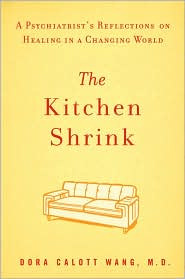
Very few literary books have been written by Chinese-American authors from Los Angeles. In May, Penguin Books published the memoir of Chinese-American medical school professor Dora Calott Wang, M.D. "The Kitchen Shrink: A Psychiatrist's Reflections on Healing in a Changing World" is Dr. Wang's memoir of working as a physician and psychiatrist in today's dysfunctional health care system. Dr. Wang is a graduate of the Yale School of Medicine and the UCLA Neuropsychiatric Institute. She is currently Assistant Professor of Psychiatry at the University of New Mexico School of Medicine. She grew up in Los Angeles and remembers when Monterey Park had only two Chinese restaurants.
(王达玲教授现为新墨西哥州大学医学院精神病学助理教授)
http://search.barnesandnoble.com/The-Kitchen-Shrink/Dora-Calott-Wang-MD/e/9781594487538/?itm=1&USRI=dora+calott+wang
It is currently the #1 nonfiction bestseller at Kepler's Bookstore in Menlo Park, and it received a starred review from Kirkus Reviews. The Kitchen Shrink: A Psychiatrist's Reflections on Healing in a Changing World is my memoir of working as a psychiatrist and physician, and engages issues of health care reform. Yet it is grounded in my identity as a Chinese American who grew up in the San Gabriel Valley of Los Angeles, something uncommon for a literary book.
Synopsis
The personal story of how a psychiatrist confronts the profound changes sweeping the medical establishment as they reshape her life and career.
In the past two decades, a seismic shift has occurred within the walls of our nation's hospitals and doctor's offices. The medical profession- once considered a sacred, cherished vocation-has devolved into a business motivated by a desire for profits. Even psychiatry, once the mainstay of the human interaction between doctor and patient, has fallen victim to rising costs and dictates by insurance sources.
How has medicine strayed so far from its roots? In The Kitchen Shrink, psychiatrist and lecturer Dora Calott Wang delves into what happened.
Through the prism of her own story, Wang elucidates key events in her professional life-the declining state of hospitals and clinics, the advent of managed care, and the rise of profits at the expense of patient care-that highlight the medical profession's decline. Along the way we meet some of her patients, whose plights reflect the profession's growing indifference to the human lives at risk. There's Selena, whose grief over her mother's death and lack of family support make it difficult for her to take the medicine that keeps her body from rejecting her new liver, and Leonard, a schizophrenic with no health insurance who develops peritonitis and falls into a coma for three months. Each new story brings additional compromises as the medical landscape shifts under Wang's feet. She struggles with depression and exhaustion, witnesses the loss of top doctors who leave in frustration, and attempts to find a balance between work and home as it becomes everclearer that she cannot untangle the uncertain future of her patients from her own.
Part personal story and part rallying cry, The Kitchen Shrink is an unflinchingly honest, passionate, and humane inside look at the unsettling realities of free-market medicine in today's America.
Kirkus Reviews
A beautifully written memoir about the author's frustration with the transformation of the profession of medicine into the business of health care, and the unraveling of the doctor-patient bond. As a leading psychiatrist, Wang has witnessed how "the insurance company has replaced the doctor as a patient's primary medical relationship." During her time as chief of the Psychiatry Consultation-Liaison Service at the University of New Mexico Hospital, her caseload was more than 1,000 new patients each year. She documents how this kind of pressure has been created by insurers with deep pockets who have driven independent doctors out of business by undercutting their fees, refusing to authorize necessary treatments and underpaying doctors for care that is authorized. In the 1990s, Wang welcomed the introduction of the new generation of anti-depressants. However, she soon realized that insurance companies would refuse to pay psychiatrists for treating patients with therapy-"Prozac, even at three dollars a pill, costs[s] far less than regular sessions with a highly trained psychotherapist." Even though dedicated doctors work long hours at lower pay, tragically their efforts are undermined by profit-mad insurance companies, a transformation that began with the Reagan administration's flawed argument that the free market would drive down escalating medical costs. The author recounts a number of tragic stories:e.g., a young woman in need of a second liver transplant who could not receive it because the facility where she was originally treated had closed down; an overworked physician so dedicated that she didn't take time to get her own symptoms checked, and died suddenly of "acute complications ofleukemia." Even though Wang has recently cut back her practice in order to care for her young daughter, her commitment as a healer remains:"Every life is precious. Each life is worth our best effort. Each life lost is an alternate, possibly better world that didn't happen."A thoroughly compelling message-without an ethical commitment to the value of every life, "the very humanity of our society" is at stake. Agent:Michael Carlisle/Carlisle & Company
Biography
Dora Calott Wang, M.D., is a psychiatrist who has degrees from the Yale School of Medicine and the University of California-Berkeley. She has been in private practice, has served on hospital staffs, and has been a medical school instructor. Dr. Wang also has a master's in English from Berkeley.














 打印本文章
打印本文章

